BrightKB
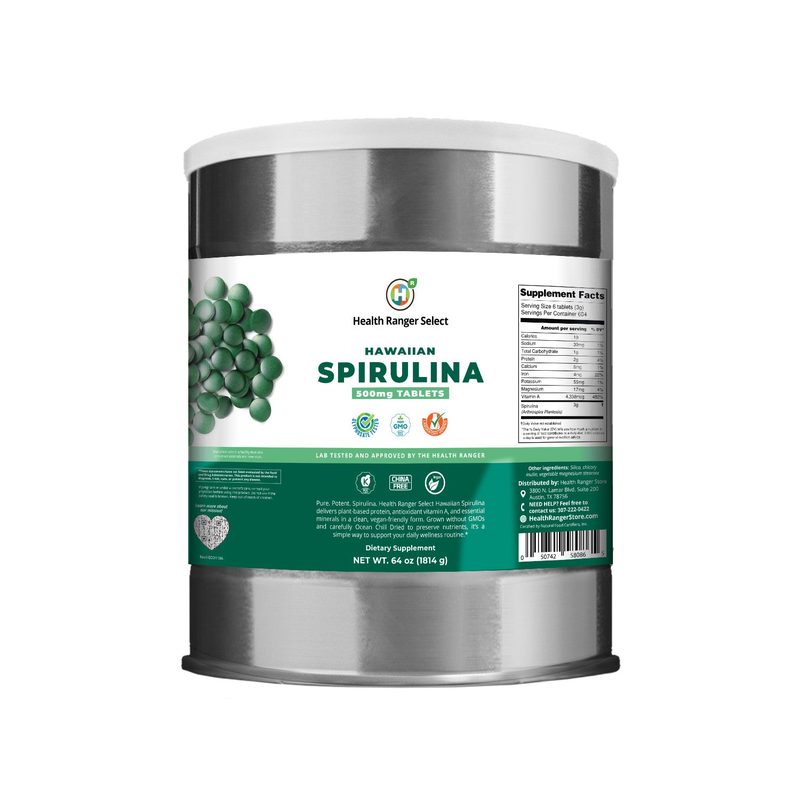
Health Ranger Select Hawaiian Spirulina cold-pressed 500 mg tablets in a 64 oz #10 can
Spirulina

Hawaiian Spirulina Cold Pressed 500mg Tablets (64oz, 1814g), approximately 3628 tablets (#10 Can)

Health Ranger Select Hawaiian Spirulina is a cold-pressed tablet supplement made from spirulina cultivated in open ponds in Hawaii. Each #10 can holds 64 ounces, about 3628 tablets of 500 mg.

By Health Ranger Select · sold at the Health Ranger Store

Go Directly to Store

Opens this product’s page at HealthRangerStore.com, where you will find the current price, sizes, the full label and availability.

About Hawaiian Spirulina Tablets

Health Ranger Select Hawaiian Spirulina is sold as cold-pressed 500 mg tablets in a 64-ounce (#10) can. The can contains approximately 3628 tablets. The product is listed under Spirulina.

The spirulina is cultivated in open ponds using 100% fresh potable water from Hawaiian aquifers combined with ultra-pure deep ocean water that contains all 94 trace minerals and elements. It is grown in a Biosecure Zone.

After cultivation, the spirulina is gently dried with patented Ocean Chill Drying technology and then cold-pressed into tablets. The finished product is lab-verified and contains no gluten, pesticides, solvents, herbicides or GMOs. It is non-China, non-irradiated and vegan, and has been lab tested for glyphosate, heavy metals and microbiology.

The store lists this product under Spirulina. The tablets are a plain, cold-pressed form of the cultivated spirulina, with no other ingredients named. The can is sized for bulk storage. The tablets are cold-pressed and can be taken as part of a daily routine. Store the can sealed in a cool, dry place.

At a glance

  • FormCold-pressed 500 mg tablets
  • CountApproximately 3628 tablets
  • Size64 oz (1814 g) #10 can
  • Water SourceHawaiian aquifer and deep ocean water
  • CertificationsNon-GMO, vegan, non-irradiated, non-China
  • TestingLab tested for glyphosate, heavy metals, microbiology

What BrightKB’s sources say about Spirulina

The notes below were drawn from BrightKB, a free knowledge base of facts extracted from books, articles and papers. They describe the ingredients in general, not this product in particular, and each one is traced to the source it came from.

What spirulina is

Spirulina is a type of blue-green algae that is also described as a microalgae and as a type of micro-algae.[1][2][3] It is classified as a type of cyanobacteria, which places it among the blue-green algae rather than among larger seaweeds.[4] Because it grows as a single-celled organism, spirulina is grouped with the microalgae in general descriptions of the ingredient.[2][3] Spirulina is a complete protein, meaning it supplies protein in a form that is described as complete.[5] Alongside its protein content, spirulina contains chlorophyll, the green pigment associated with algae and plants.[6] Spirulina also contains phycocyanin, a pigment that occurs in this type of blue-green algae.[7] In addition, spirulina contains gamma-linolenic acid, a fatty acid found within the microalgae.[8] Spirulina is a source of iron, and this mineral content is noted among the things the algae provides.[9]

Composition and kitchen use

The pigments chlorophyll and phycocyanin both occur in spirulina, and together they are part of what the algae contains.[6][7] Gamma-linolenic acid is another component of spirulina, listed among the substances the microalgae contains.[8] Spirulina is a source of iron as well as a complete protein, and both are described as part of what the ingredient provides.[5][9] As a type of blue-green algae and a type of cyanobacteria, spirulina is a microalgae that is handled as a food ingredient in kitchens.[1][2][4] Spirulina is used in the kitchen as an ingredient in its own right, and it is described as a complete protein and a source of iron in that context.[5][9] The chlorophyll and phycocyanin in spirulina are part of its composition, and the gamma-linolenic acid it contains is another of its components.[6][7][8] Spirulina is a microalgae, and it is grouped with the blue-green algae and the cyanobacteria in descriptions of what it is.[1][2][3][4] Its protein content is described as complete, and its iron content is described as a source, so both are noted among the things spirulina supplies.[5][9]

See Hawaiian Spirulina Tablets in the store

The current price, the sizes and the full ingredient label are on the product’s own page.

Go Directly to Store